Many women over 40 do exactly what they have always done: they watch their calories, eat less, choose the lighter option. And yet they notice their body changing — silent muscle loss, more belly fat, less energy after exercise, a sense of satiety that evaporates. What used to work now delivers different results. This is not a question of discipline. It is a question of the hormonal environment — and whether the right nutritional principle is in place.
Summary: Why protein is so important for women in perimenopause
- Declining oestrogen inhibits muscle protein synthesis — the body needs more protein for the same effect
- Muscle mass is the most important metabolic engine: without targeted support it silently decreases from age 35
- Protein satiates longer, stabilises blood sugar and dampens cortisol responses after eating
- Recommended: 1.6–2.0 g per kg of body weight daily, spread across several meals
- 25–35 g of protein per meal promotes muscle protein synthesis more effectively than one large portion at once
- Protein + strength training work synergistically — either alone is significantly less effective
Protein does not just protect muscles. It changes how the body handles hunger, energy and body composition — especially when hormone levels are shifting.
Topics in this article
Around 45% of women consume too little protein — particularly during stressful life phases or from their mid-thirties onwards, when life is full and eating often happens on the side. At the same time, hormonal changes begin during this phase that slowly but measurably increase protein requirements.
It is not about forcing yourself into a high-protein diet. It is about understanding why protein takes on a different significance in perimenopause — and what that means concretely for everyday life.

A protein-rich breakfast stabilises blood sugar and satiety for hours.
Why Protein Suddenly Counts More in Perimenopause
Oestrogen is far more than a reproductive hormone. It influences how cells respond to protein — how well muscle tissue can be built and maintained, how sensitively cells respond to insulin, and how the body recovers after physical exertion.
When oestrogen begins to fluctuate in perimenopause and declines long-term, this hormonal framework changes fundamentally. The body no longer responds the same way to the same stimuli. This applies to training — and it applies to nutrition.
Oestrogen, Insulin and the Changing Metabolism
Oestrogen acts as an insulin sensitiser: it helps cells absorb glucose and use it more efficiently. As oestrogen levels decline, insulin sensitivity changes. Blood sugar fluctuates more. The body begins to prefer storing energy as fat — particularly in the abdominal area.
At the same time, fat distribution shifts: away from hips and thighs, towards visceral fat tissue. This change happens regardless of whether a woman eats less or exercises more. It is hormonally driven — and that is precisely why the body often no longer responds to classic calorie counting in the same way during this phase.
The Silent Shift from the Mid-Thirties
From around the age of 35, muscle mass begins to slowly decline without targeted stimulus — even if it is barely perceptible at first. In perimenopause this process accelerates. A 2026 review published in the Journal of Cachexia, Sarcopenia and Muscle shows that the transition to perimenopause is associated with a measurable decline in lean body mass — with further accelerated loss after menopause.
Muscle mass is not an aesthetic detail. It is the body's most active metabolic engine. Those who lose muscle also reduce their basal metabolic rate — and eventually have the feeling of gaining more weight on the same diet, without anything actually having changed.
"Calorie counting measures quantity. Protein is a question of quality — and in perimenopause, that is precisely what makes the difference."
Anabolic Resistance — When the Body Responds Differently to Protein
There is a phenomenon that rarely appears in popular nutrition guides, yet explains a decisive difference: Anabolic Resistance.
This refers to the reduced ability of muscle to respond to protein and training with building or maintenance reactions. With increasing age and declining oestrogen, the body literally needs more protein — and a stronger training stimulus — to achieve the same anabolic response that previously required less input.
Julia, 43, self-employed, describes it this way: "I had always exercised. Always paid attention to nutrition. And yet suddenly everything felt different. I recovered less well, my sleep became lighter. After intense sessions I didn't feel stronger — I felt empty. I thought I needed to become more disciplined. Today I know: my body didn't need more pressure. It needed more regulation."
Anabolic resistance does not mean protein stops working. It means the threshold is raised. Those who previously got by with 1.0 g/kg of body weight now need 1.6–2.0 g/kg to achieve the same muscle preservation. That is not a weakness — that is biology.
Muscle Mass as an Underestimated Metabolic Engine
Muscles burn calories — even at rest. A more muscular body has a higher basal metabolic rate. Those who lose muscle mass over years because protein intake is too low and strength training is absent also silently lose metabolic capacity.
Muscle mass is also one of the most important insulin sensitivity factors: muscles absorb glucose from the blood independently of insulin. This is particularly relevant in perimenopause, when insulin-mediated glucose uptake already becomes less efficient.
More muscle mass means in practice: more stable blood sugar, less sugar cravings, more consistent energy, slower weight gain over the years. This is not a promise — it is physiology. And protein is the building block for it.
- Muscles are the body's largest glucose storage organ
- Strength training measurably increases the insulin sensitivity of muscle cells
- Without protein, strength training cannot trigger optimal muscle protein synthesis
- Adequate protein protects against the creeping loss that often goes unnoticed for years

Breakfast with adequate protein and complex carbohydrates — the first building block for stable energy in the morning.
How Much Protein Do Women in Perimenopause Need?
The official recommendations of the German Nutrition Society (DGE) stand at 0.8 g of protein per kg of body weight daily. For active women over 35 — and particularly for women in perimenopause — the scientifically discussed recommendation is significantly higher.
A 2023 review published in the journal Nutrients concludes that 1.0–1.2 g/kg daily forms a meaningful baseline for perimenopausal women — for physically active women focused on muscle preservation, 1.6–2.0 g/kg is realistic and supported by current research.
Concrete Numbers
- 1.6–2.0 g per kg of body weight daily The scientifically recommended range for active women in perimenopause. At 60 kg that equates to 96–120 g of protein per day, at 70 kg approximately 112–140 g.
- 25–35 g of protein per meal This amount is considered threshold-effective for muscle protein synthesis. Distribution throughout the day is just as important as the total amount — 80 g at once is less effective than 3 × 30 g.
- Set protein consciously at breakfast Many women eat particularly carbohydrate-heavy in the morning. A protein-containing breakfast stabilises blood sugar, reduces hunger in the afternoon and gives the body important building blocks directly after the overnight fast.
- Leucine as the key amino acid Leucine is the amino acid with the strongest anabolic signal. Animal protein sources (eggs, yoghurt, fish, meat) are particularly rich in leucine. Those eating plant-based should combine sources and plan for larger quantities.
Why Distribution Matters
The body cannot use an unlimited amount of protein at once for muscle protein synthesis. Someone who eats 70 g of protein in one evening meal and little for the rest of the day benefits less than a woman who distributes the same amount evenly across three meals.
This has a practical implication: it is not just about what is eaten in total, but how it is spread throughout the day. Breakfast, lunch and dinner can each function as protein anchors — if one pays deliberate attention to this.
The Protein Leverage Effect: Why the Body Eats Until It Has Enough Protein
There is a mechanism that explains why many women in perimenopause experience a persistent feeling of hunger despite a low-calorie diet: the Protein Leverage Effect.
The basic idea: the body has a strong biological drive to meet its protein needs. When the diet is low in protein, it keeps eating until the protein requirement is fulfilled — or switches to cravings and energy deficits. Those who eat little protein therefore often consume more total calories without realising it.
Conversely: those who increase their protein intake feel satisfied more efficiently, need less overall volume and incidentally stabilise blood sugar. This also explains why many women, after increasing their protein intake, report that they respond less to sweet cravings and no longer experience the afternoon energy slump.
Not eating less — eating differently. The focus shifts from calorie quantity to nutrient density. And protein is the decisive lever.
Bones, Collagen and Protein — An Underestimated Connection
Protein is almost exclusively associated with muscles. Yet it is also essential for bone health — an aspect that is underestimated in perimenopause, when the risk of osteoporosis increases as oestrogen declines.
Bones are not just calcium. The bone matrix consists of roughly one third collagen — a protein that gives bones elasticity and tensile strength. Those who eat too little protein do not supply the body with enough building blocks for this bone architecture. Calcium supplements alone are then less effective than hoped.
A study in Nutrients (2018) on muscle and bone health in menopause shows that the combination of adequate protein, vitamin D and targeted strength training has a synergistic protective effect on musculoskeletal health — significantly more effective than individual measures alone.
This means: protein does not just protect muscles. It is a fundamental building block for bones, connective tissue, tendons and skin — for the entire structural framework that carries the body in the long term.
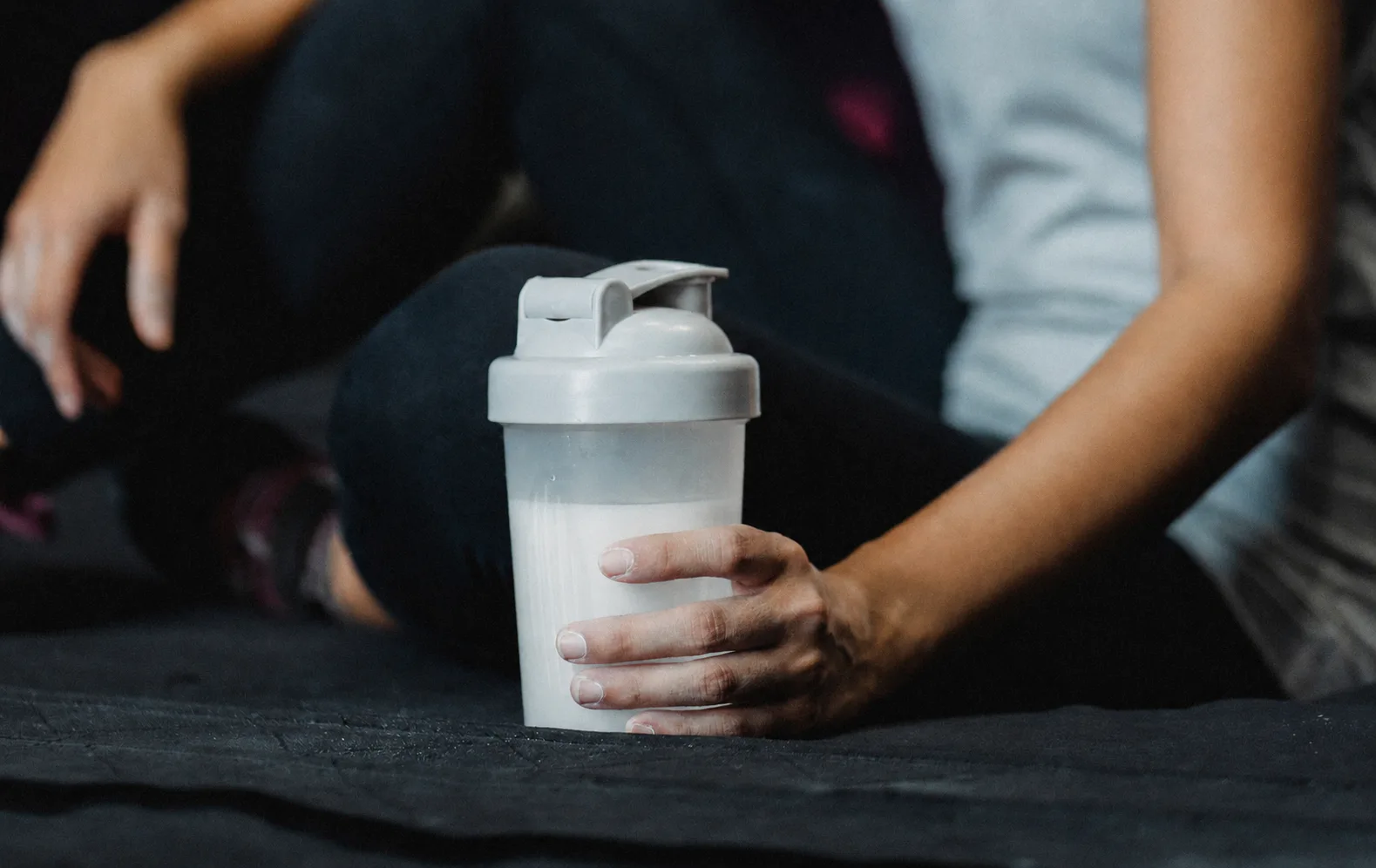
Protein shakes can usefully supplement — but do not replace a complete meal.
Protein in Everyday Life — A Concrete Example Day
Theory is helpful. Concrete numbers help even more. Here is an example day for a woman weighing 65 kg aiming for approximately 110 g of protein — without supplements, without extremes:
| Meal | Example | Protein approx. |
|---|---|---|
| Breakfast | 200 g Greek yoghurt (10% fat) + 1 egg + 40 g oats + nuts | ~30 g |
| Lunch | 150 g chicken breast or salmon + vegetables + legumes or quinoa | ~35 g |
| Snack | 2 hard-boiled eggs + handful of almonds or quark with fruit | ~18 g |
| Dinner | Scrambled eggs (3) + cottage cheese + plenty of vegetables + 1 slice wholegrain bread | ~30 g |
| Total | ~113 g | |
This day illustrates: it is not a diet. Not a logic of deprivation. It is a deliberate distribution of protein across all meals — using natural foods, without counting or optimising.
For those not yet accustomed to this, one thing quickly becomes apparent: it is more filling. Less desire for sugar in the afternoon. Breakfast lasts longer. The evening becomes calmer because hunger is more even throughout the day.
When Are Protein Supplements Useful?
Protein from whole foods is always the first choice. However, those who struggle to reach their target during stressful periods, after training or while travelling can use protein powder as a practical supplement — not a replacement, but a tool.
High-quality whey isolates or casein (slowly absorbed, ideal in the evening) work well. Those avoiding lactose will find good alternatives in pea or rice protein — preferably without additives and with a simple ingredient list. Collagen powder alone should not be relied upon for muscle building: collagen contains no leucine and is not a complete protein.

Eggs are one of the most nutrient-dense protein sources — rich in leucine, quick to prepare, versatile.
Strength Training + Protein: Why the Combination Matters
Protein alone is not enough. Training alone is not enough either. Only the interplay of both unfolds the full effect on muscle mass, metabolism and body composition.
Strength training gives the muscle the stimulus — the call to adapt. Protein provides the material for this adaptation. Without adequate protein after strength training, the body cannot respond optimally. Without strength training, protein has no destination, no signal to respond to.
What the Science Says
A randomised controlled trial (Rossato et al., 2017) examined precisely this relationship in postmenopausal women: both groups — one with 0.8 g/kg protein, one with 1.2 g/kg — gained similar amounts of lean mass after 10 weeks of strength training. This shows: strength training is the primary driver. Protein creates the framework conditions.
This means: those who eat a lot of protein but do no strength training will benefit significantly less. And those who train but eat too little protein limit the potential of every training session. Both together — that is the mechanism that works in the long term.
- 2–3 strength training sessions per week are sufficient — no daily maximum required
- Compound exercises (squats, deadlifts, rows, pressing) activate the most muscle groups
- Protein within 1–2 hours after training supports recovery
- Recovery is part of the process — no less important than training itself
What About Calorie Counting? An Honest Assessment
A calorie deficit works. That is biologically undeniable. If more energy is consistently consumed than taken in, body weight will decline in the long term.
But calories are not equal to calories — when it comes to body composition. 200 kcal from protein have a different metabolic effect than 200 kcal from sugar. Protein satiates more strongly, has a higher thermic effect (the body uses more energy to digest it) and provides building blocks that fat cannot provide.
Those who only reduce calories in perimenopause without increasing protein and protecting muscle mass often lose both fat and muscle — and end up with less muscle mass and therefore a lower basal metabolic rate than before. A cycle that is difficult to reverse.
This is not an argument against mindful eating. It is an argument for asking the right question: not "how little can I eat?" but "what does my body need to function well in the long term?"
The Key Takeaways:
Protein for women in perimenopause is not a trend — it is a physiological necessity arising from declining oestrogen levels and anabolic resistance.
The target: 1.6–2.0 g/kg daily, distributed across meals of 25–35 g — from whole foods such as eggs, yoghurt, legumes, fish and lean meat.
Protein protects not just muscles but also bones, stabilises blood sugar and satiety, and changes how the body handles hunger.
Strength training + protein work together. Either alone is less effective.
The focus shifts: from eating less to eating better — with protein as the foundation.
Frequently Asked Questions
How much protein do I need as a woman in perimenopause per day?
The scientifically recommended range is 1.6–2.0 g of protein per kilogram of body weight daily for active women in perimenopause. For a woman weighing 65 kg, that equates to approximately 104–130 g of protein per day — ideally spread across 3–4 meals of 25–35 g each.
Why is protein more important in perimenopause than in younger years?
As oestrogen declines, the body's ability to synthesise muscle protein decreases — a phenomenon known as anabolic resistance. At the same time, the risk of muscle loss, insulin resistance and bone density reduction increases. Protein counteracts these processes — but the body now needs more of it to achieve the same effect as before.
Should I eat protein before or after training?
Both timings can be beneficial. More important than the exact timing is the total daily amount and its distribution across several meals. A protein-rich meal within 1–2 hours after training supports muscle repair — a light protein-rich snack beforehand can stabilise training performance.
Is plant-based or animal protein better in perimenopause?
Animal protein sources such as eggs, yoghurt, fish and lean meat have a high leucine content and are directly bioavailable. Plant-based sources such as legumes, tofu, tempeh and nuts complement well. A combination of both is nutritionally ideal — those eating purely plant-based should set their total amount slightly higher and pay attention to protein variety.
Can eating more protein help with weight loss in perimenopause?
More protein supports a stable body weight by increasing satiety, dampening blood sugar fluctuations and promoting muscle preservation. Weight loss is a possible side effect — not the primary goal, but often a consequence as protein regulates appetite and body composition improves through muscle preservation.
Why am I gaining weight in perimenopause despite eating healthily?
Declining oestrogen reduces insulin sensitivity and shifts fat distribution towards the abdomen — regardless of calorie intake. At the same time, muscle mass silently decreases, which lowers the basal metabolic rate. Those who eat too little protein and do no strength training lose muscle mass over years and eventually notice the difference — without their diet having changed.
Scientific Sources
- Erdélyi A. et al. (2023). The Importance of Nutrition in Menopause and Perimenopause — A Review. Nutrients. pmc.ncbi.nlm.nih.gov
- Menzies C. et al. (2026). Menopause, Female Sex Hormones, Skeletal Muscle Mass and Muscle Protein Turnover in Humans. Journal of Cachexia, Sarcopenia and Muscle. pmc.ncbi.nlm.nih.gov
- Agostini D. et al. (2018). Muscle and Bone Health in Postmenopausal Women: Role of Protein and Vitamin D Supplementation Combined with Exercise Training. Nutrients. pmc.ncbi.nlm.nih.gov
- Rossato L.T. et al. (2017). Higher Protein Intake Does Not Improve Lean Mass Gain When Compared with RDA Recommendation in Postmenopausal Women Following Resistance Exercise Protocol. Nutrients. pmc.ncbi.nlm.nih.gov
FemBalance Living · Guides
Nutrition, strength training and hormonal health — tailored to work together.
The FemBalance Guide presents these connections in concrete terms: with protocols for protein timing, training structure and recovery — specifically for women over 35. Scientifically grounded, practically applicable, instantly available digitally.
Explore All Guides