You can't feel oestrogen or progesterone directly. What you feel is what they leave behind: a night of solid sleep versus a night of staring at the ceiling, a calm week versus one where everything feels one notch too loud. Most of the time these two hormones balance each other out quietly, in the background. The moment that balance tips — across a cycle, under stress, or somewhere in your mid-30s — you notice.
Oestrogen and progesterone are the two primary female sex hormones — and they work in almost opposite ways.
- Oestrogen builds: the uterine lining, bone density, collagen, cardiovascular protection
- Progesterone regulates and calms: it prepares the body for a possible pregnancy and has a settling effect on the nervous system
- Oestrogen leads the first half of your cycle, progesterone the second
- From your mid-30s, progesterone typically drops first, while oestrogen swings more unpredictably — this mismatch explains many early perimenopause symptoms
- An imbalance often shows up as poor sleep, worse PMS, mood swings or a shifting cycle
Understanding how the two work together makes it much easier to read your own body's signals — instead of reading them as something going wrong.
Topics in this article
Roughly 8 in 10 women experience hormonal or stress-related symptoms well before they reach what most people picture as menopause — often without ever finding out which hormone is actually behind it. Oestrogen and progesterone tend to get lumped together in conversation, even though they do very different jobs. Knowing what each one is responsible for is often the difference between a symptom that makes sense and one that just feels unsettling.
Both hormones are produced mainly in the ovaries and, in a regular cycle, follow a predictable rhythm. Once you're through your mid-30s, that rhythm starts to shift — quietly at first, then more noticeably. Understanding the basics of what oestrogen and progesterone actually do makes it much easier to understand why your body can start to feel different, without anything being wrong with it.

FemBalance Living / brand_assets
Two Hormones, Two Completely Different Jobs
Both hormones belong to the female sex hormone family, but they work in almost opposite directions. Put simply: oestrogen builds, progesterone regulates and settles. It's the interplay between the two — not either one alone — that adds up to what doctors call hormonal balance.
Oestrogen: the builder
Oestrogen — or more precisely oestradiol, its most active form — builds the uterine lining in the first half of the cycle and supports the development of breast tissue. But its influence reaches far beyond reproduction: oestrogen supports bone density, collagen production, blood vessel health and metabolism. That's exactly why its decline around menopause is felt so broadly throughout the body. A review of bone density during perimenopause found that bone loss in late perimenopause already accelerates to 1.8–2.3% a year at the spine — considerably earlier than most women expect.
Progesterone: the regulator
Progesterone takes over in the second half of the cycle. According to a physiology overview of progesterone, it prepares the uterine lining for possible implantation and, if pregnancy occurs, keeps the uterine muscle relaxed. What's less widely known: through its metabolite allopregnanolone, progesterone also acts on GABA receptors in the brain — a study on allopregnanolone and sleep found effects that closely resemble those of benzodiazepines. That's why progesterone is often described as the body's own calming hormone — and why sleep tends to get worse in the days right before your period, exactly when progesterone drops. There's more on this in our article on waking up at night and hormones.
"Oestrogen builds. Progesterone regulates. Most symptoms don't come from one hormone alone — they come from the ratio between the two."
How They Take Turns Across Your Cycle
In a regular cycle, the two hormones follow a set pattern. During the follicular phase, oestrogen rises and prepares the body for ovulation. After ovulation, the corpus luteum takes over progesterone production, and it becomes the dominant hormone for the rest of the cycle.
- Follicular phase: oestrogen rises, the uterine lining builds up
- Ovulation: oestrogen peaks, progesterone starts to rise
- Luteal phase: progesterone takes the lead, preparing for a possible pregnancy
- Without fertilisation, both hormones drop toward the end of the luteal phase — and your period starts
This rhythm also explains why the second half of your cycle can feel so different from the first: slower, calmer, sometimes more sensitive. That isn't a flaw in the system — it's progesterone doing exactly what it's meant to do.
What Changes Once You're Past 35
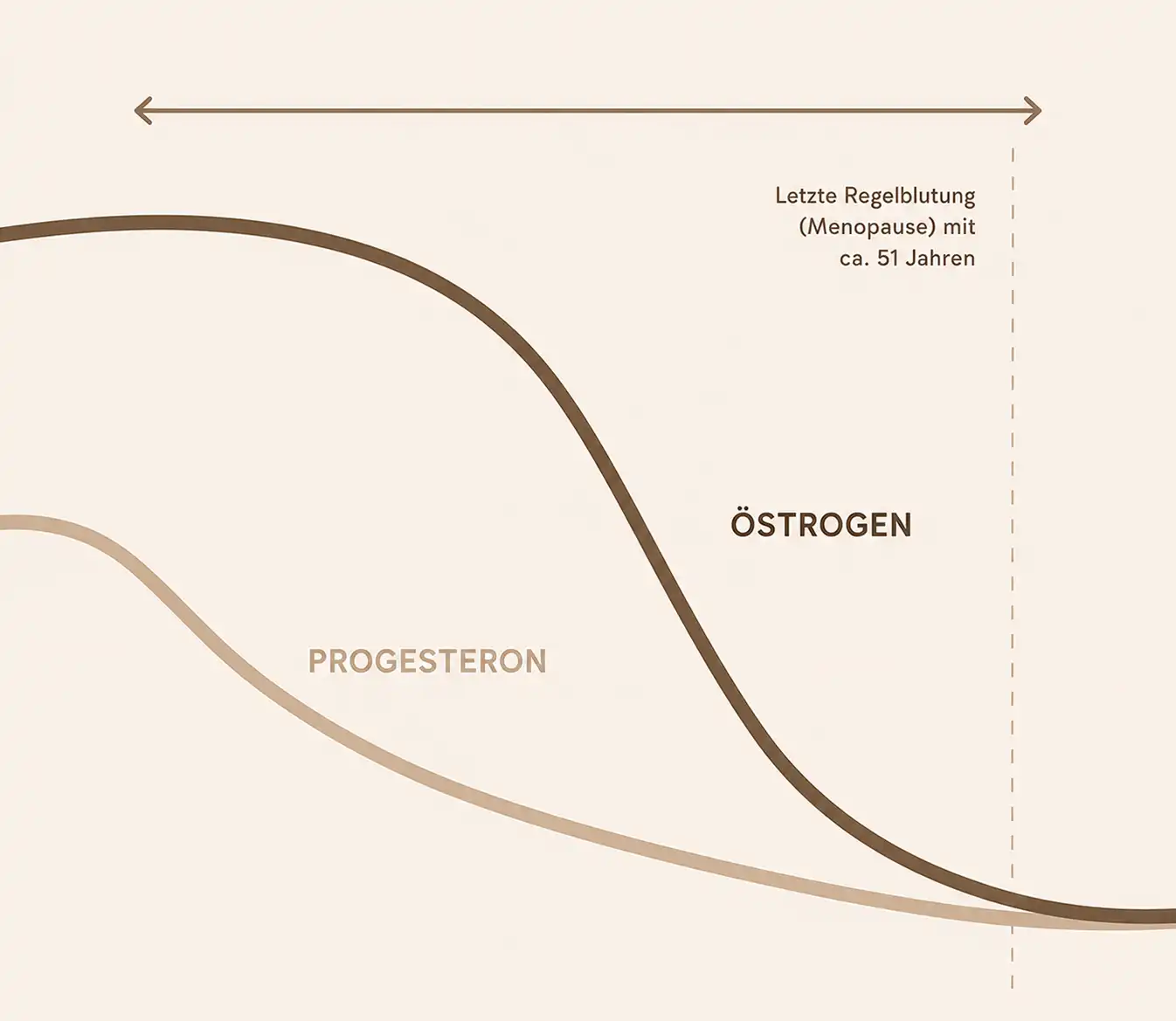
Perimenopause tends to start earlier than most people assume — often as early as the mid-30s — and it can stretch on for 7 to 10 years. Progesterone is usually the first to drop noticeably, simply because ovulation stops happening as reliably every month. Oestrogen doesn't decline in a neat, gradual line — it tends to swing more than it used to, sometimes running higher, sometimes lower than what your body was used to.
FemBalance Living / brand_assets
It's this mismatch — not a simple shortage of either hormone — that explains a lot of early perimenopause symptoms. Progesterone often starts dropping years before your final period (which lands, on average, around age 51), while oestrogen can keep swinging for a long time after that. For many women, this stretch of unpredictability feels harder to navigate than menopause itself, because the cycle and the symptoms can look different from one month to the next.
One client in her early 40s described it this way: for months, her sleep had been getting worse in the second half of her cycle, and she felt more on edge than usual — at first, she put it down to a stretch of stress at work. It was only once she connected the timing to the natural drop in progesterone before her period that the pattern suddenly made sense. Not as a diagnosis, just as an explanation that finally matched what she was actually feeling.
The Symptoms That Overlap and Confuse Everyone
Low progesterone and relative oestrogen dominance produce symptoms that overlap heavily — and in daily life, they're rarely experienced as two separate things.
Which symptoms usually appear together, and the four causes that can sit behind them, is set out in our overview of hormonal imbalance and how to spot the signs.
- Poor sleep before your period As progesterone drops in the second half of your cycle, its calming effect on the nervous system fades — falling and staying asleep both get harder.
- Worse PMS than usual Irritability, breast tenderness and mood swings are classic signs that progesterone is relatively low compared to oestrogen.
- An irregular or shorter cycle A sign that ovulation isn't happening as reliably every month — which means progesterone production is fluctuating too.
- Water retention and weight fluctuations A relative oestrogen excess can encourage fluid retention and affect how satisfied you feel after eating.
The term "oestrogen dominance" doesn't actually mean oestrogen is too high in absolute terms — it describes a ratio: progesterone has fallen relatively more than oestrogen, so oestrogen ends up outweighing it. It isn't a formal clinical diagnosis, but it's a pattern plenty of women recognise in the years leading up to perimenopause.
Why "Balance" Is a Better Frame Than "Dominance"
A lot of guides present oestrogen dominance as a problem to be fixed — with tests, supplements or strict diet plans. FemBalance Living sees it differently: a shifting ratio between oestrogen and progesterone is the norm during perimenopause, not a malfunction. The more useful question isn't "how do I stop this?" — it's "how do I support my body through it?"
Chronic stress makes the imbalance harder to manage. Cortisol and progesterone share the same biochemical precursor, and under sustained pressure, progesterone can effectively get diverted toward cortisol production — compounding a decline that's often already underway. You can read more about that connection in our article on cortisol vs. perimenopause.
- Keep blood sugar steady 25–35g of protein per main meal helps prevent the blood sugar swings that push cortisol up and put extra strain on hormonal balance.
- Protect your sleep routine Consistent sleep times support the circadian rhythm — exactly the system progesterone's calming effect depends on.
- Strength training 2–3× a week Targeted strength training improves insulin sensitivity and helps regulate the stress response, without overloading the nervous system.
- Build in daily stress regulation Short daily resets support hormonal balance far more reliably than the occasional long stretch of relaxation.

FemBalance Living / brand_assets
Oestrogen builds, progesterone regulates and calms — most symptoms come from the ratio between the two, not from either hormone alone.
From your mid-30s, progesterone usually drops first while oestrogen swings more unpredictably — that combination explains a lot of early perimenopause symptoms.
Sleep, blood sugar, strength training and daily stress regulation support both hormones at once — no matter which one is currently more out of step.
Frequently Asked Questions
What is the difference between oestrogen and progesterone?
Oestrogen is the builder: it drives the first half of your cycle, thickening the uterine lining and supporting bone density, collagen and cardiovascular health. Progesterone is the regulator: it takes over in the second half, prepares the body for a possible pregnancy, and has a calming effect on the nervous system. In short — oestrogen builds, progesterone settles things down.
What does progesterone actually do in the body?
Progesterone prepares the uterine lining for a possible pregnancy and helps sustain it once implantation occurs. Beyond reproduction, its metabolite allopregnanolone acts on GABA receptors in the brain — in a way that resembles a mild, natural sedative — which is why progesterone is closely linked to sleep quality and emotional steadiness.
What does oestrogen actually do in the body?
Oestrogen builds the uterine lining and breast tissue, but its reach goes well beyond reproduction — it supports bone density, collagen production, blood vessel health and metabolism. When oestrogen drops significantly, as it does around menopause, bone loss accelerates measurably within a short window.
What are the signs of low progesterone?
Common signs include poor sleep in the second half of your cycle, worse-than-usual PMS, irritability, a shorter cycle or spotting between periods. Because these symptoms overlap with other causes, tracking your cycle over a few months is often more revealing than a single hormone test.
What does oestrogen dominance actually mean?
It doesn't mean oestrogen itself is too high — it describes a ratio: progesterone has dropped relatively more than oestrogen, so oestrogen ends up outweighing it. It isn't a formal clinical diagnosis, but it does describe a pattern many women notice in the years leading up to perimenopause.
How do oestrogen and progesterone change in your mid-30s?
Progesterone is usually the first to drop noticeably, because ovulation starts happening less consistently. Oestrogen doesn't decline in a straight line — it swings more than it used to, sometimes higher, sometimes lower. That imbalance, not a simple shortage, explains many early perimenopause symptoms like disrupted sleep, stronger PMS or mood swings.
FemBalance Living · Guides
Oestrogen, progesterone and perimenopause — go deeper with concrete protocols.
The FemBalance Guide breaks down the connections between oestrogen, progesterone and the nervous system, specifically for women over 35 — with protocols for sleep, your cycle and hormonal balance during perimenopause. Science-based, practical, available digitally.
Discover All Guides