She does everything right. Trains regularly, pays attention to adequate protein, sleeps reasonably well. And yet: recovery takes longer than before. Energy feels different — flatter, less stable, less predictable. Concentration fluctuates. Julia, 43, had known this feeling well since her mid-30s. For a long time she believed it was down to a lack of discipline. Until she understood what hormonal shifts do to cellular energy — and what creatine has to do with it for women over 35.
At a glance: What does creatine do for women over 35?
- Creatine supports muscle mass, strength and recovery — particularly relevant from age 35, when natural muscle loss begins
- Oestrogen enhances creatine transport into cells — with declining oestrogen, this efficiency diminishes
- Creatine acts not only in muscle, but also in the brain: cognitive energy, memory, mental endurance
- 3–5 g creatine monohydrate daily — no loading phase needed, no tight time windows
- Women with predominantly plant-based diets benefit particularly strongly, since creatine occurs almost exclusively in animal foods
The image of creatine as a supplement for bodybuilders is outdated. Research in recent years shows a considerably broader spectrum of action — which is particularly relevant for women over 35.
Topics in this article
Creatine monohydrate is the most extensively researched supplement of all. Over a thousand studies demonstrate its efficacy — in strength, endurance, recovery and increasingly in cognitive function too. And yet, when most women hear the word creatine, they still think first of men, muscle mass and weightlifting.
This misunderstanding has a cost. Because women naturally have around 70–80% lower endogenous creatine stores than men — and therefore benefit proportionally even more strongly from targeted supplementation. Particularly from age 35, when hormonal shifts begin that directly influence the creatine system.
In women who eat plant-based diets, the effect is even more pronounced: creatine occurs almost exclusively in meat and fish. Those who rarely or never eat these foods often have chronically low creatine stores — frequently without knowing it.
What creatine really does in the body
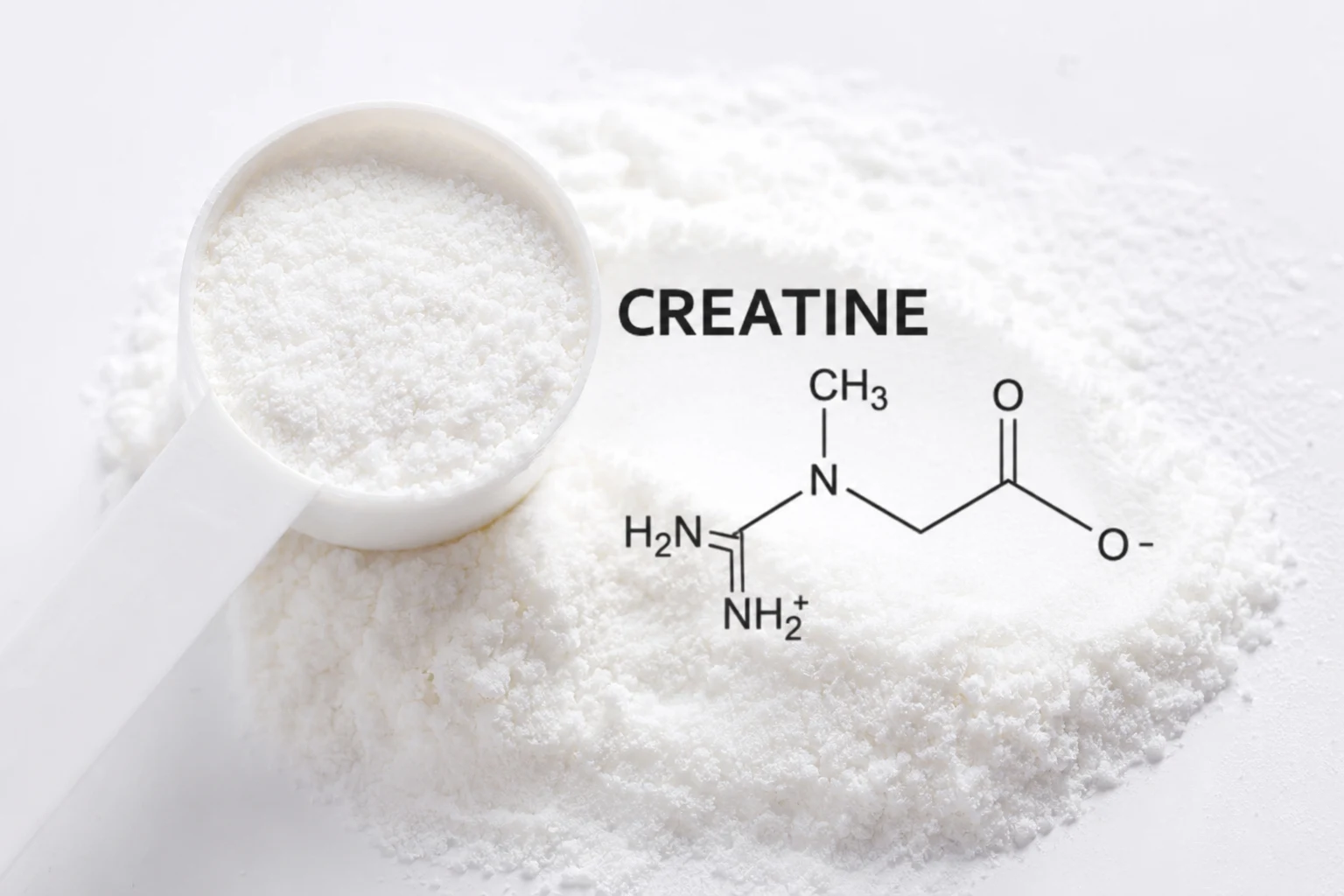
Creatine is not a synthetic substance. The body produces it itself — from the amino acids arginine, glycine and methionine, primarily in the liver and kidneys. Additionally, we take in creatine through animal foods, particularly beef, pork and fish.
In the body, creatine is converted to phosphocreatine and stored in muscle and brain cells. There it serves as a fast energy reserve: it regenerates ATP — the primary energy carrier of every cell — particularly in moments of high demand, when normal energy production doesn't run fast enough.
What this means in everyday life: faster recovery between training sessions, more available strength, less muscle fatigue. But also better cognitive endurance — because the brain also depends on a functioning phosphocreatine system, especially in periods of stress or sleep deprivation.
"Creatine is not a bodybuilder supplement. It is cellular energy — for muscle, brain and bones."
Why creatine becomes particularly relevant for women over 35
Oestrogen as a natural creatine enhancer
What most people don't know: oestrogen actively influences the expression of the creatine transporter — the protein that shuttles creatine into the cells. As long as oestrogen is sufficiently present, this transport runs efficiently. With declining oestrogen — which begins for many women from their mid-30s — this mechanism becomes less efficient. The body is less able to store and use creatine.
Sports scientist Dr Stacy Sims, who has been researching female exercise physiology for years, describes this connection as a key reason why creatine is particularly sensible for women in the perimenopausal phase. The declining oestrogen level doesn't just make supplementation possible — it makes it physiologically justified.
Protecting muscle mass — an active process from age 35
From around age 35, muscle mass begins to decline slowly without targeted training. This process accelerates with hormonal shifts in perimenopause. Muscle mass is simultaneously one of the most important protective factors for metabolism, insulin sensitivity and healthy ageing — it is not an aesthetic matter, but a medical one.
Creatine cannot stop this process alone. But it demonstrably improves the effectiveness of strength training for women: women who train regularly and supplement with creatine show stronger gains in muscle mass and muscle strength in studies than women who only train. The effect is particularly pronounced in women over 50 — but it begins to work earlier.
- Creatine improves protein synthesis in muscle cells after training
- More available ATP means higher training quality — and a stronger training stimulus
- Faster recovery enables more frequent and more consistent training sessions
- In combination with adequate protein (1.6–2.0 g/kg daily), an effective synergy system is created
Creatine and cognitive energy — more than just muscle strength
The brain consumes a disproportionately large amount of energy — around 20% of the body's total caloric needs. And it depends on a functioning phosphocreatine system, especially in periods of high cognitive demand, stress or inadequate sleep.
Several studies show that creatine supplementation can improve memory, cognitive performance and reaction time — especially under sleep deprivation and chronic stress. Precisely the states that many women over 35 know well.
Clara, 38, a marketing manager, described it this way: "I was permanently tired, but my head was simultaneously constantly active. I thought for a long time that was simply my everyday life." Creatine is not a stress hormone regulator — but it can noticeably support the cellular energy supply of the brain in periods of increased demand.
Particularly relevant: women who eat vegetarian or vegan diets show stronger cognitive responses to creatine supplementation in studies — presumably because their creatine baseline levels in the brain are lower.
Creatine, bones and healthy ageing
Bones are not static tissue. They are permanently built up and broken down — and need energy for this. From perimenopause onwards, when oestrogen declines, this process begins to get out of balance: breakdown increasingly outweighs build-up.
Creatine alone is not bone protection. But in combination with strength training, there is increasing evidence that creatine can positively influence bone-forming cells (osteoblasts) — via improved cellular energy supply in bone tissue too. Studies show particularly positive effects on bone markers in postmenopausal women when creatine is combined with regular strength training.
The strongest documented approach for bone and muscle health from age 35 remains the combination: strength training 2–3x per week + adequate protein + creatine. No element replaces the others — but together they potentiate each other.

Dosage and intake — what is really necessary
The good news: creatine supplementation is simpler than it is often presented. No complicated loading protocols, no tight time windows, no cycle management.
- Amount 3–5 g creatine monohydrate daily. This is the dosage best supported in research. Women with lower body weight can start with 3 g — most studies with women use 3–5 g daily.
- Form Creatine monohydrate is the most extensively researched and most effective form. More expensive variants such as creatine HCl, creatine ethyl ester or buffered creatine have not demonstrated superior efficacy. The inexpensive standard form is the best choice.
- Timing There are indications that creatine is minimally better absorbed after training — but the effect is small. Consistency is more important than timing. Once daily, dissolved in water, juice or a smoothie.
- Loading phase Not necessary. 20 g daily for 5–7 days fills stores faster, but also increases the risk of gastrointestinal discomfort. 3–5 g daily without loading achieves the same result after 4 weeks — with considerably better tolerability.
- Duration Creatine can be supplemented permanently. Breaks are not necessary and bring no demonstrated benefit. Those who pause lose the built-up creatine level within a few weeks.
Three misconceptions that hold women back
"Creatine makes you bloated." This myth is persistent — and half-true. Creatine does bind water, but intracellularly: in the muscle cells themselves, not in the subcutaneous adipose tissue. Well-hydrated muscle cells are more powerful and recover faster. This is not a side effect — it is the mechanism. Women who forgo a loading protocol barely experience this effect measurably.
"That's for athletes, not for me." Studies show the opposite: less trained women and women with lower baseline creatine levels respond proportionally more strongly to supplementation than elite athletes. The gap between their current and possible creatine level is larger for them.
"With a healthy diet, I don't need that." Through food, a maximum of 1–2 g of creatine can be absorbed daily — and only if meat or fish are regularly on the menu. To reach the amounts relevant for women over 35, daily portions of several hundred grams of meat would be necessary. Supplementation is the more pragmatic path.
The most important points at a glance
My Product Recommendations
Transparency note: This article serves general information purposes and does not replace individual medical advice. Some of the products recommended in the article may contain affiliate links. If you purchase through these links, you support FemBalance Living at no additional cost to you.
Frequently Asked Questions
Is creatine safe for women over 35?
Yes. Creatine monohydrate is considered safe at the recommended daily dose of 3–5 g. Long-term studies over several years show no negative effects on kidney, liver or hormonal system in healthy adults. Women with existing kidney disease should seek medical advice beforehand.
When do you feel the effects of creatine?
First effects on training performance and recovery typically appear after 2–4 weeks of regular intake. Cognitive effects can be noticeable earlier in periods of increased stress or sleep deprivation. Full creatine stores are built up after approximately four weeks of daily intake.
Do you need to do creatine loading?
No. The classic loading protocol (20 g daily for 5–7 days) fills stores faster, but is not necessary. 3–5 g daily without loading leads to the same result after approximately four weeks — with less risk of gastrointestinal discomfort. For most women, the simple daily protocol is clearly the better choice.
Does creatine cause water retention?
Creatine binds water — but intracellularly, in the muscle cells themselves. Not in the subcutaneous adipose tissue. Well-hydrated muscle cells are more powerful and recover faster. Women without a loading protocol barely experience this effect measurably. The image of a "bloated" figure comes from older studies with high loading doses in male athletes.
Can women who eat plant-based diets benefit particularly from creatine?
Yes, very likely even more strongly than women with high meat consumption. Creatine occurs almost exclusively in animal foods. Vegan and vegetarian women often have lower endogenous creatine stores — and therefore respond more clearly to supplementation. Creatine monohydrate itself is synthetically produced and is vegan.
Is creatine useful in perimenopause?
Yes — and the justification is directly physiological: with declining oestrogen, the body loses a natural enhancer of creatine transport. At the same time, the risk of muscle loss, cognitive changes and bone loss increases — three areas where creatine has good research evidence in combination with strength training. Creatine complements strength training and protein intake, but does not replace them.
FemBalance Living · Guides
Muscle mass, energy & hormonal health — made concrete for your everyday life.
The FemBalance Guide breaks down the connections around strength training, protein, recovery and supplements specifically for women over 35 — scientifically grounded, practical for everyday life, instantly available digitally.
Discover All Guides